
Review Solutions for Online Education
Give prospective learners clearer context about course delivery, instructor support, platform usability, expectations, and the overall learning experience.
Buy Trustpilot Reviews
Choose a structured Trustpilot review campaign with transparent pricing, gradual delivery, and clear progress tracking.
View Service- Coming soon
Buy Google Reviews
Explore structured Google review campaign options for your business with clear expectations, gradual delivery, and transparent support.
View Service - Coming soon
Buy Google Play Reviews
Explore Google Play app review and rating campaigns with gradual delivery, clear tracking, and support for Android publishers.
View Service - Coming soon
Buy Yelp Reviews
Explore Yelp review campaigns for your business with gradual delivery, clear tracking, and transparent support.
View Service



Reduce Uncertainty Before Enrollment
Prospective learners may compare curriculum, format, instructors, support, time commitment, and price before choosing a program. Reviews can add real-world context about the learning experience when they remain accurate and specific.

Request Reviews After Meaningful Course Milestones
Feedback should follow enough participation for the learner to evaluate the experience. Depending on the program, that may be after a completed module, a cohort milestone, course completion, or a support interaction.
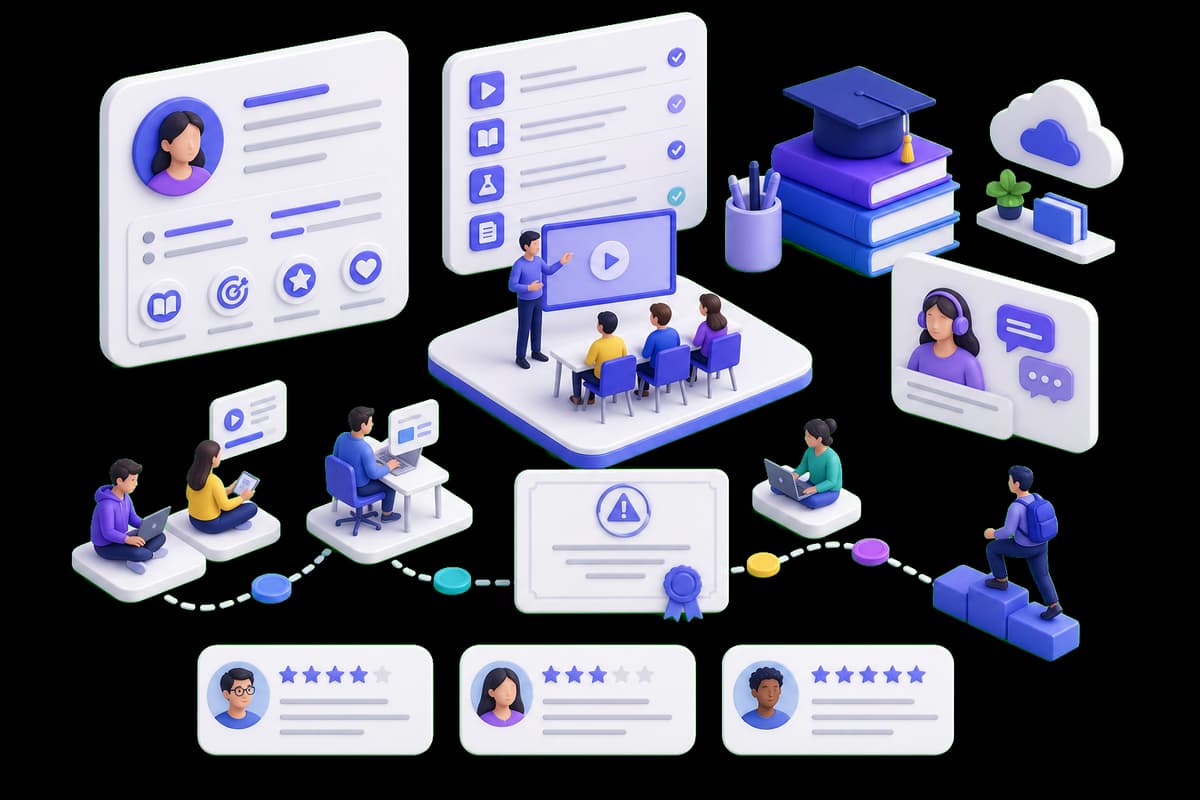
Build Trust Without Promising Guaranteed Outcomes
Education reviews can discuss course structure, teaching, resources, community, and support. Providers should avoid encouraging unsupported claims about employment, income, certification, admissions, or other outcomes that vary by learner.
How Reviews Influence Online Course Enrollment Decisions
Online education purchases are made under significant uncertainty. A prospective learner cannot attend a sample class, cannot verify the instructor's teaching quality in advance, and cannot know whether the course community will be engaged. Reviews reduce that uncertainty in specific ways that education providers can deliberately support.
What prospective learners look for in course reviews
Research on online course enrollment decisions shows that prospective learners prioritise three types of information in reviews: clarity about what the course actually covers versus what the sales page implied, specifics about the workload and time commitment required, and honest assessment of instructor accessibility and support quality. Reviews that address these three areas convert significantly better than reviews that simply express enthusiasm. A review that says 'the course changed my life' provides emotional social proof but little decision-relevant information. A review that says 'I expected a six-hour commitment but the course took 18 hours; the content was worth it but only if you have that time' gives the next prospective learner exactly what they need to make an informed decision—and if they enroll knowing the real commitment, they are more likely to complete and less likely to leave a frustrated review later.
The completion-review gap and how to close it
Most online course reviews come from a self-selected group: learners who completed the course and had a strong experience. Completion rates for online courses are notoriously low—studies across major platforms report average completion rates of 10 to 15 percent for self-paced courses. This means that 85 to 90 percent of enrolled learners never reach the natural review-request moment (course completion), which creates a skewed review profile. Providers who only request reviews at completion hear from the most engaged, highest-satisfaction subset of their learner base. A more representative review process requests feedback at earlier milestones—after the first module, after the first live session for cohort programs, or after a learner achieves a specific in-course milestone—when a larger percentage of learners are still active and can provide feedback that reflects the early experience more broadly.
The Regulatory and Ethical Boundary on Career Outcome Claims in Education Reviews
Online education reviews frequently contain claims about career changes, salary increases, job placements, and professional credentials. How providers handle these claims—in the reviews they promote and in how they respond publicly—has significant compliance and ethical implications.
FTC and ASA rules on educational testimonials
In the United States, the Federal Trade Commission's guidelines on endorsements and testimonials apply directly to how educational providers use learner reviews in marketing. If a provider promotes a review claiming 'I got a job at Google after this course' or 'I doubled my salary in six months,' the FTC requires that this result be typical of what learners generally achieve—or that a clear disclaimer discloses that results are not typical. Using a single exceptional testimonial without disclosure in promotional materials is a violation of these guidelines, and the FTC has taken enforcement action against educational companies for exactly this practice. In the UK, the ASA and CAP Code impose similar requirements on educational advertising. Providers who republish review content in their own marketing—on landing pages, in social media, in email campaigns—are responsible for the claims those reviews contain.
How to respond to outcome-focused reviews without amplifying compliance risk
When a learner leaves a public review describing a specific career or financial outcome, the provider faces a choice about how to respond that has compliance implications. A response that celebrates the outcome enthusiastically—'Congratulations, this is exactly what we built this course for!'—implicitly endorses the claim and could be read as the provider affirming that this result is typical. A more defensible response acknowledges the learner's experience without making the outcome the centrepiece: 'Thank you for sharing your experience—we are glad the course supported you in moving forward in your career. We appreciate you taking the time to leave detailed feedback.' This response is warm, genuine, and does not create the impression that the provider is representing the outcome as typical or guaranteed. Providers should have their response templates reviewed by a marketing compliance or legal team before publishing them across multiple reviews.
Online Education Review Management Questions
Answers about learner invitations, review timing, outcome claims, platform selection, and privacy.
Reviews can help prospective learners understand course delivery, teaching, platform usability, support, workload, and the overall experience before they enroll.
Only accurate and properly contextualized experiences should be published. Providers should not encourage guaranteed employment, income, admissions, certification, or other claims that cannot be substantiated.
Avoid confirming enrollment details, assessment results, payment information, or support records in public responses. Move individual cases to a secure private channel.
Ask after the learner has completed enough of the program to provide informed feedback, such as a meaningful module, cohort milestone, or the full course. State clearly which experience is being reviewed.
Trustpilot can support company-level research, while course marketplaces may host program-specific ratings. The right platform depends on how learners discover and purchase the course.
Use clear and consistent eligibility criteria based on genuine participation. Do not invite only learners expected to leave positive feedback or suppress invitations after a complaint.
Learn More About Reviews for Online Education
Guides on Trustpilot strategy, review legitimacy, and responsible review campaigns for online courses and education platforms.



Explore More Digital Reputation Solutions
Discover how other online businesses use public feedback to support customer trust.
E-commerce
Build buyer confidence with a stronger public review presence for your online store.
Explore IndustrySaaS Companies
Support software evaluation and sales with credible review signals across the customer journey.
Explore IndustryDigital Agencies
Turn client feedback into visible proof of service quality, reliability, and expertise.
Explore IndustryFinancial Services
Strengthen customer confidence with transparent reputation management for financial brands.
Explore Industry
Build More Trust Before Learners Enroll
Compare Trustpilot campaign options or discuss a responsible review strategy for your courses and programs.